Alexandria: Egypt's Mediterranean Jewel
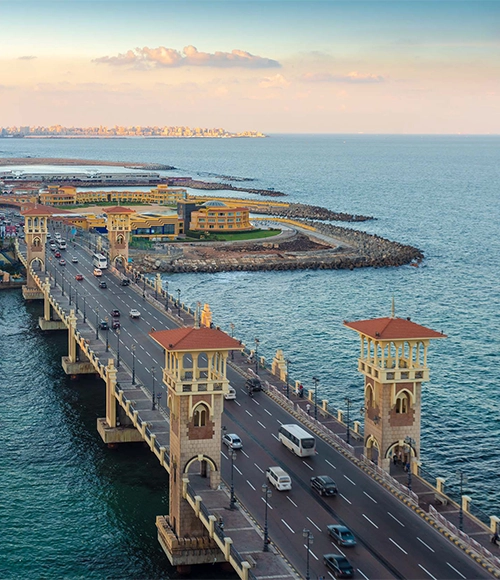
Alexandria sits gracefully along Egypt's Mediterranean coast, approximately 225 kilometers northwest of Cairo. The city stretches along a narrow strip of land between the Mediterranean Sea and Lake Mariout, a unique geographic position that has influenced its development throughout history.
Alexandria, as Egypt's second largest city, attracts travelers with its unique blend of ancient wonders and Mediterranean charm. Here, Greco-Roman ruins stand alongside modern attractions, creating a captivating destination where history and contemporary culture intertwine.
The city's strategic location has made it a natural gateway between Egypt and the Mediterranean world. Its position along major trade routes contributed to its historical importance and continues to influence its modern role as Egypt's primary port.

A Brief History of the City
Alexandria's story begins in 331 BCE when Alexander the Great chose this coastal location to establish a city that would bear his name. The city's founding marked the beginning of an extraordinary chapter in ancient history, as Alexandria quickly grew to become one of the most important cities in the ancient world.
Under the Ptolemaic dynasty, Alexandria flourished as a center of learning and culture. The famous Library of Alexandria and the Lighthouse of Alexandria, one of the Seven Wonders of the Ancient World, established the city's reputation for intellectual and architectural achievement. Scholars, philosophers, and scientists from across the Mediterranean world came to study and work in Alexandria's institutions.
The Roman period brought continued prosperity, though the city's character gradually evolved. Early Christianity found fertile ground in Alexandria, and the city became an important center for Christian theology and scholarship. The Islamic conquest of 641 CE marked another significant transformation, as Alexandria adapted to its new role within the expanding Islamic world.
During the medieval period, Alexandria's importance as a trade center continued, though it never quite regained its ancient prominence. The modern era brought renewed attention to the city, particularly during the 19th and early 20th centuries, when Alexandria became home to a cosmopolitan community of Greeks, Italians, Jews, and other Mediterranean peoples.
Top Attractions in Alexandria
Bibliotheca Alexandrina – The Modern Library of Alexandria
The Bibliotheca Alexandrina stands as modern Alexandria's most ambitious cultural project. Opened in 2002, this striking building serves as both a tribute to the ancient Library of Alexandria and a contemporary center for learning and research. Its distinctive circular design and slanted roof create an architectural landmark that has become synonymous with modern Alexandria.
Inside, visitors discover much more than a library. The complex houses multiple museums, including the Manuscript Museum, the Antiquities Museum, and the Sadat Museum. The planetarium offers programs in multiple languages, while the conference center hosts international academic and cultural events throughout the year.
The main reading room impresses with its vast space and natural lighting. Even non-researchers can appreciate the building's design and browse the public areas. The library's collection includes both print and digital resources, reflecting Alexandria's historical role as a bridge between different cultures and its contemporary commitment to accessible knowledge.


Qaitbay Citadel – A Fortress on the Sea
The Citadel of Qaitbay occupies one of Alexandria's most historically significant locations. Built in the 15th century by Sultan Qaitbay, this fortress stands on the exact site where the ancient Lighthouse of Alexandria once guided ships into the harbor.
The fortress itself represents excellent Mamluk military architecture. Its thick walls and strategic position demonstrate the defensive considerations that influenced its design. Visitors can explore the various chambers, climb to the ramparts for harbor views, and examine the cannons that once defended Alexandria against Ottoman naval attacks.
Beyond its historical significance, Qaitbay Citadel offers some of Alexandria's best photographic opportunities. The combination of medieval Islamic architecture, Mediterranean views, and fishing boats in the harbor creates scenes that capture Alexandria's unique character.
The Catacombs of Kom El Shoqafa
The Catacombs of Kom El Shoqafa represent one of the most remarkable archaeological sites in Alexandria, showcasing the city's unique blend of Egyptian, Greek, and Roman cultural influences. Dating to the 2nd century CE, these underground burial chambers were carved into the bedrock and served as a necropolis for Alexandria's wealthy residents.
Descending into the catacombs reveals three levels of tombs and chambers, decorated with a fascinating mixture of pharaonic and classical motifs. The main tomb chamber features reliefs that combine Egyptian gods with Roman imperial symbols, demonstrating the cultural synthesis that characterized Alexandria during the Roman period. The serpent-headed Agathodaimon and other hybrid deities reflect the religious syncretism of ancient Alexandria.

Pompey's Pillar and the Serapeum
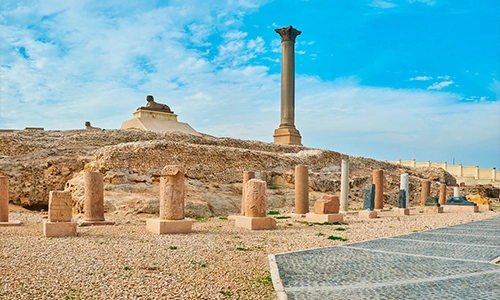
Pompey's Pillar dominates the Alexandria skyline as the city's most prominent ancient monument. This massive granite column, standing nearly 27 meters tall, actually has nothing to do with the Roman general Pompey despite its name. The column was erected around 297 CE in honor of Emperor Diocletian and originally stood within the Serapeum, Alexandria's second most important temple complex after the Great Library.
Alexandria National Museum
The Alexandria National Museum offers an excellent introduction to the city's complex history. Housed in a restored Italian-style palace, the museum's three floors organize artifacts, allowing visitors to trace Alexandria's development from ancient times through the Islamic period to the modern era.
The ground floor focuses on the Pharaonic period, displaying artifacts that demonstrate Alexandria's connections to ancient Egyptian civilization despite its later founding date. Greek and Roman antiquities on the first floor include statues, coins, and everyday objects that illustrate life in ancient Alexandria. The collection includes pieces recovered from underwater excavations, providing glimpses of the submerged portions of the ancient city.
The second floor covers the Coptic and Islamic periods, showing how Alexandria adapted to changing religious and cultural influences. The museum's manageable size makes it possible to see everything in a few hours, while the quality of the displays and multilingual labels help visitors understand Alexandria's place within Egypt's broader historical narrative.


Montaza Palace and Gardens
Montaza Palace and its surrounding gardens provide a peaceful retreat from Alexandria's urban energy. Built in the early 20th century as a summer residence for the Egyptian royal family, the palace complex demonstrates the European influences that shaped modern Alexandria's architecture and lifestyle.
The palace itself, built in a mix of Ottoman and Florentine styles, now serves as a museum showcasing royal furnishings and personal items. However, the real attraction lies in the extensive gardens that surround the buildings. These landscaped grounds include both formal gardens with geometric designs and more natural areas with walking paths that wind through diverse plantings
Hotels and restaurants may be crowded, but the city takes on a festive atmosphere during these months.
Winter (December to February) features cooler temperatures and occasional rainfall. While some visitors prefer these conditions for walking and sightseeing, the Mediterranean can be rough, limiting water based activities.